It was standing room only at the Go Addressable 2025 Summit, where over 350 agency, brand and industry partners gathered for an afternoon of content and conversation exploring how addressable TV advertising is redefining the modern media landscape. Capping off a year where the lines between traditional, digital, and streaming platforms continued to blur, our agenda reinforced the growing importance of precision, brand safety and performance as basic tables takes for advertisers, and why high-fidelity deterministic identity is driving addressable advertising’s evolution from niche tactic to foundational strategy.
Demonstrating Go Addressable’s commitment to simplifying, socializing, and scaling the full power of deterministic, audience-based advertising at the speed of digital, several announcements were made leading up to the event and further discussed on stage, including:
- New research, jointly commissioned by Go Addressable and CIMM and executed by Truthset, The Challenges of Using IP Address for Audience Identification and Measurement, breaking down the alarming IP-to-email match accuracy rates of ~16% and IP-to-Postal accuracy rates of ~13% and why more deterministic identifiers are in advertisers’ best interest.
- An ‘easy button’ to #goaddressable, our National Addressable Counts initiative, developed in partnership with Blockgraph, Epsilon, Experian and TransUnion, automates audience counts to drive accuracy and performance across the approximately 70MM unduplicated households within the Go Addressable footprint.
- Key findings from Advertiser Perceptions illuminate addressable TV advertising’s continued momentum (four years and counting): including a +72% lift in advertiser satisfaction with addressable TV options since 2022.
- Capitalizing on addressable TV’s momentum, Go Addressable welcomed new supporting members this year – Adobe, Ampersand, Basis, Epsilon, FOX, Hearst Television, INVIDI Technologies, iSpot and TransUnion.
Go Addressable Chairman, Matt Van Houten captured Go Addressable’s 2025 impact perfectly: “I feel like we’ve caught lightning in a bottle.”
He described addressable TV as a win for everyone—viewers get relevant, less repetitive ads; brands and agencies reach the right person at the right time with less waste; and inventory owners match yield more efficiently. “Everybody wins,” he said.
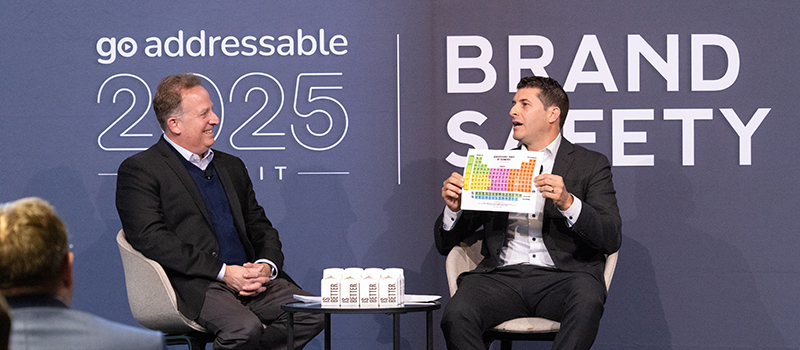
Speakers: Rob Rasko, Brand Safety Summit Series & Matthew Van Houten, Go Addressable & DIRECTV Advertising
With Go Addressable Summit sponsors Epsilon, Mastercard and TransUnion, the 5th annual summit showcased how collaboration is fueling measurable progress. As Van Houten noted, 85% of buyers report satisfaction with their addressable campaigns—but the work to educate, evolve, and scale is just getting started.
Here is a breakdown of this year’s program:
Identity in Motion: Measurement That Moves with the Audience
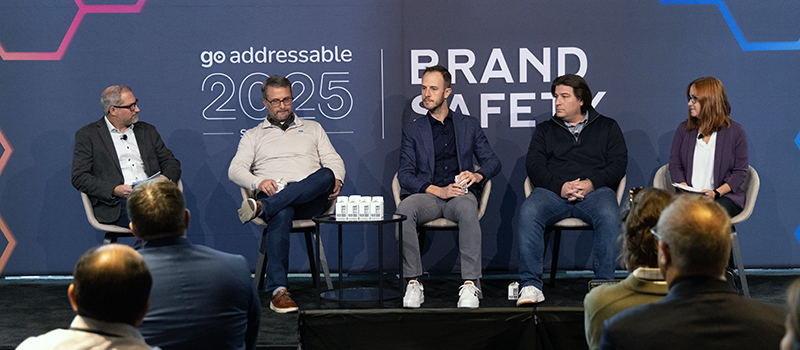
Speakers: Larry Allen, Go Addressable & FreeWheel; Trevor Hamilton, Kochava; Jason Manningham, Blockgraph; Stu Schwartzapfel, iSpot; and Jen Soch, WPP Media.
The panel dug into one of the industry’s biggest challenges—keeping measurement in sync with audience behavior. “We (consumers) are changing consumption at a pace never seen before,” said Jason Manningham, CEO of Blockgraph. “People move between platforms and devices, but households don’t—and that’s the foundation for understanding reach, frequency, and outcomes.”
For Jen Soch, Executive Director of Channel Solutions at WPP, emphasized household identity as the key to accurate reach while improving frequency planning. To get there she suggested being deterministic first, but probabilistic smart.
Stu Swartzapfel, VP of Media Partnerships at iSpot added that, “Unification of measurement holistically across all the top publishers operating today with normalizing standards are the biggest challenges. A couple of years ago our industry spoke about the incrementality of CTV to traditional (linear) TV. Now the conversation has shifted to, ‘What’s my incrementality from publisher to publisher?’”
Speed was another theme—the panel predicted a future of always-on optimization where agencies make proactive, AI-assisted decisions mid-flight. Manningham added that expanding household data to neighborhood insights can unlock new retail opportunities, since proximity is still one of the greatest predictors of purchase.
Key Takeaway
Identity is no longer a nice to have—it’s the engine powering precision, performance, and the ability to optimize with speed.
The Addressable Advantage: Unlocking Precision for TV’s Biggest Moments and Fans

Speakers: Lauren Schweitzer, DISH Media; Martin Blich, WPP Media; April Weeks, Basis Technologies; Howard Shimmel, Janus Strategy & Insights
Addressable advertising is transforming live sports, driven by streaming and real-time ad technology. Sports providers have re-architected their platforms to manage bids and dynamic ad insertion in real time.
The agency panelists called sports the driver behind live programming today — live is the new prime time.
For Howard Schimmel, Founder of Janus Strategy and Investment, sports value lies in its engagement: “Not all impressions are created equal. Advertisers should be willing to pay the premium because the outcomes justify the investment.”
The panel agreed that better cross-platform measurement is essential. With unified data, advertisers can track addressable sports campaigns, optimize in real time, and give even challenger brands a path into premium live sports.
Key Takeaway
As technology closes the gap between precision and passion, addressable is turning live sports from a mass-reach buy into a data-driven advantage.
How Agencies Are Rewriting the Addressable Playbook
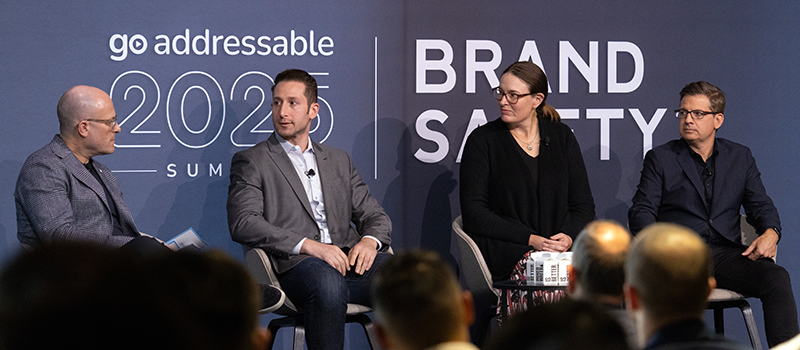
Speakers: Evan Adlman, Go Addressable and AMC Networks; Joshua Abneri, Kinesso; Kelly Metz, Spark Foundry; Mike Piner, PHD.
As digital and programmatic buying become standard, agencies are rethinking how addressable fits into omnichannel strategies. The panel explored why precision targeting has evolved from luxury to necessity.
The group highlighted how core ID and data spine capabilities have unlocked television’s power for quantifying reach and delivering seamless, audience-based buying.
Once viewed as incremental, addressable is now integral. Agencies buy audiences, not distribution, blending addressable precision with mass reach. While broad campaigns may not always require addressable, agencies are using it to balance frequency, extend reach to light-TV viewers, and deliver geographically equitable coverage based on brand needs. Creative teams are exploring how to tailor messaging simply to reach hyper-targeted audiences.
When asked where in the planning phase addressable factors in, Kelly Metz, Chief Investment Officer, Spark Foundry, said it best: “we spend so much time aligning that initial audience when we engage in the media planning process, addressable becomes a no brainer, because it becomes a means to reach that audience that we know is going to deliver results. “The one big consensus: speed—in reporting, forecasting, and audience activation—is the next frontier.
Key Takeaway
Addressable is not an add-on—it’s the backbone of how precision, performance, and creative personalization now scale together.
The Power of Addressable: Unlocking Identity and Audience Creation in the Age of Advanced TV
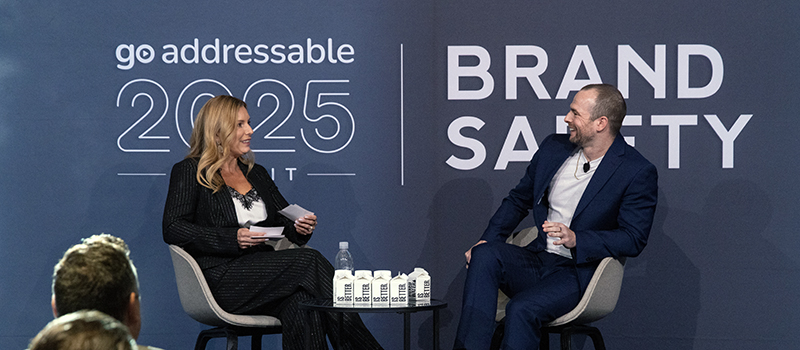
Speakers: Amanda Bates, Epsilon and Cullen Deady, PMX Lift
When Epsilon’s Amanda Bates introduced PMX Lift’s Cullen Deady, she promised we wouldn’t be disappointed — and she was right. Deady reframed identity for the group as deterministic IDs that are interoperable at the household level. That shared household currency lets brands plan, buy, and measure across linear and CTV without duplication — finally connecting who advertisers think they’re reaching with who’s actually watching.
On audience creation, Deady suggested it’s not just data slicing anymore — it’s strategic. There’s an opportunity to lead audience discovery by asking all the right questions. What’s your objective? What’s worked before? Who are you really trying to reach? Once that foundation is clear, quality data can move through planning, activation, and measurement.
Key Takeaway
The next era of Advanced TV belongs to agencies that treat audience strategy and identity not as data exercises — but as the core of how great campaigns are built.
Attribution Unlocked: Connecting TV Ads to Consumer Spend
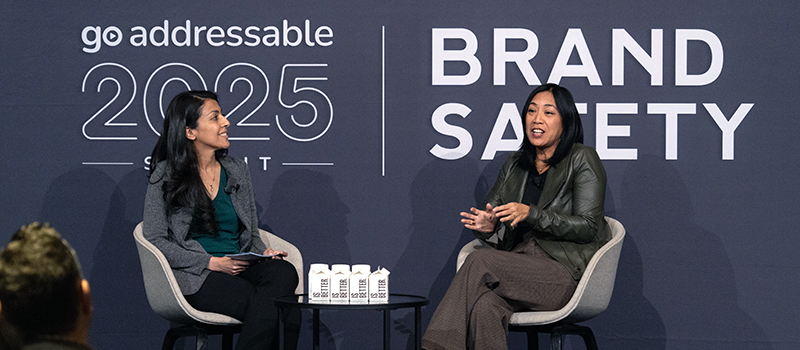
Speakers: Hania Faridi, Mastercard and Dawn Lee Williamson, Comcast Advertising
Advertisers are demanding more transparency — and measurable business outcomes — from their TV investments. This fireside chat showed how combining Comcast’s first-party viewership data with Mastercard’s transaction insights redefined attribution for TV.
According to Williamson and Faridi, marketers need a return on investment. Their partnership’s privacy-focused model delivered ROI by connecting ad exposures to real-world spending — tracking lifts in transactions, website traffic, and customer growth.
Key Takeaway
Attribution is no longer a digital-only advantage — it’s TV’s new proof point for performance, accountability, and trust.
Reach, Revenue and Results: Why Identity Is the Engine of Addressable Growth
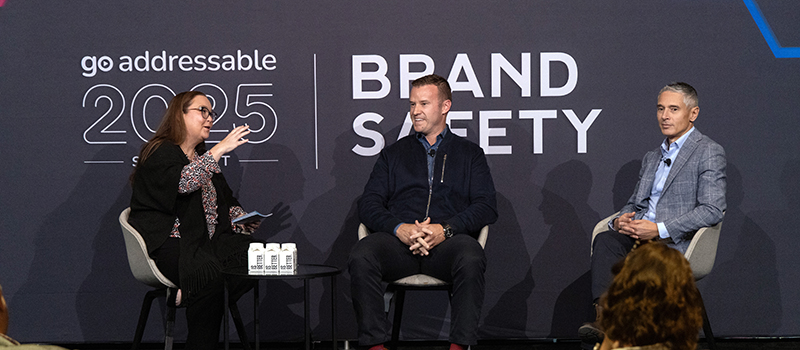
Speakers: Julie Clark, TransUnion; Dan Callahan, Spectrum Reach; Domenic Venuto, Horizon Media
Julie Clark of TransUnion sat down with Domenic Venuto, Chief Product and Data Officer at Horizon Media, and Dan Callahan, Chief Revenue Officer at Spectrum Reach, to discuss how identity drives modern addressable success.
Venuto acknowledged the rapid evolution of data and platforms, but suggested marketers still face timeless questions: Who are my best customers? Which are at risk? Where should I spend next? His advice? You can’t unlock AI’s potential without clean, unified data.
From the sell-side view, Callahan explained how Spectrum Reach is bridging traditional and streaming TV to deliver precision at scale. Transparency is critical — especially with show-level insights from Spectrum’s partnership with Gracenote linking viewing behavior to business outcomes.
Both agreed that the next frontier is reconnecting media and creative. Using data to inform creative is still underhyped, and technology now enables agencies to reunite media and creative through audience and performance signals.
Key Takeaway
Identity is the engine that powers reach, relevance, and results — turning data into a bridge between media precision and creative impact.
Go Addressable Showcase: The Future of the IP Address as a Targeting & Measurement Signal
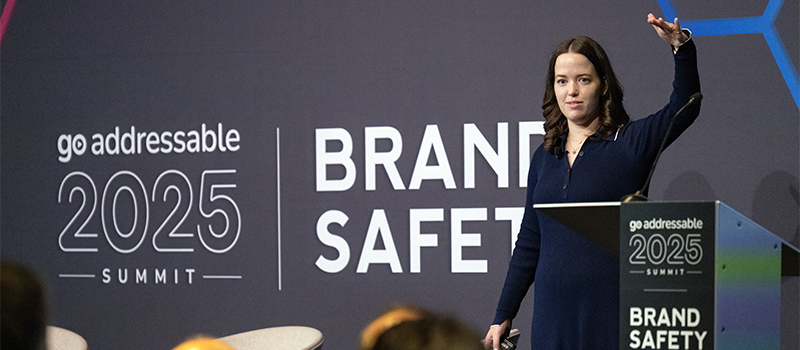
Speaker: Kathryn Barnitt, Truthset
Truthset’s Kathryn Barnitt revealed findings from a two-year study that could reshape how the industry views IP-based identity data. Commissioned by Go Addressable and CIMM, the analysis compared billions of records from six major providers against ISP and MVPD datasets — and the results were striking.
On average, IP-to-postal linkages were accurate just 13% of the time, with IP-to-email slightly higher at 16%. Accuracy varied dramatically, with the best provider more than four times as reliable as the weakest. Barnitt warned that flawed IP data ripples through the entire chain — from targeting to measurement — leading to wasted spend and misread campaign performance.
While IP addresses remain a vital signal for the connected TV ecosystem, Barnitt stressed they’re inherently unstable — shared, rotated, and often obscured by VPNs and privacy tools. The solution lies in connecting IP data to deterministic, privacy-focused identifiers like verified household addresses.
Key Takeaway
The IP address isn’t dead — but it can’t stand alone. The future of accurate targeting depends on linking it to verified privacy-focused first-party identity data.
Bringing It All Together: Let’s #GoAddressable!
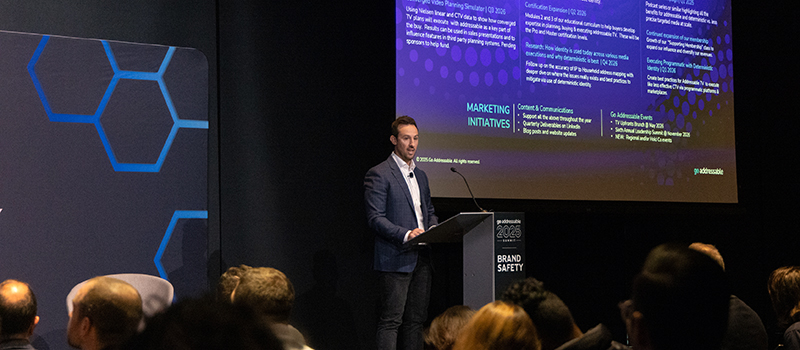
Speaker: Michael Kuntz, Spectrum Reach
Spectrum Reach’s Michael Kuntz, VP of Programmatic Sales, wrapped the Go Addressable 2025 Summit with some humor and conviction. Kuntz reflected on how far the industry has come since its forefathers drew this up a decade ago, tying together the day’s themes of identity, data, and speed—from ‘deterministic first, probabilistic smart’ approach, to debates around measurement and live sports that yielded, ‘Live is the new prime time.’
He credited partners like Epsilon, Mastercard, and TransUnion–the three sponsors of the event–for proving how data and commerce now converge to deliver true closed-loop attribution. Kuntz added one more principle to Go Addressable’s core pillars of Simplify, Socialize, and Scale =Speed. He suggested that if we can move faster together then we’ll all be back next year with even greater success stories.
Key Takeaway
The addressable era isn’t emerging—it’s here. The next leap forward will come from moving faster, together.
Go Addressable: Looking Forward to 2026
Thank you to all that joined us for the Go Addressable 2025 Summit. Your participation and collaboration help us socialize the value of addressable to the industry and push the medium forward. A couple of highlights to look forward to in 2026 include:
- A new education / certification program to help buyers gain more expertise in planning, buying and executing addressable.
- Research on best practices for using deterministic identity across all video execution platforms.
- Advertiser Perceptions’ continued commitment to do more surveys to keep their finger on the pulse of what’s happening in the eyes of the buyside.
Stay tuned for details on our third annual Go Addressable TV Upfront Brunch on May 14 and our 6th annual Go Addressable Summit in November.
To keep up to date with all the latest work we are doing, visit goaddressable.com/insights.
To watch the full replay of the event or check out the highlights here.